Have you ever worked on a project where there were plenty of people involved, everyone seemed busy, and yet somehow… things still fell through the cracks?
I have.
It made me think of this when I read about the Ringelmann effect.
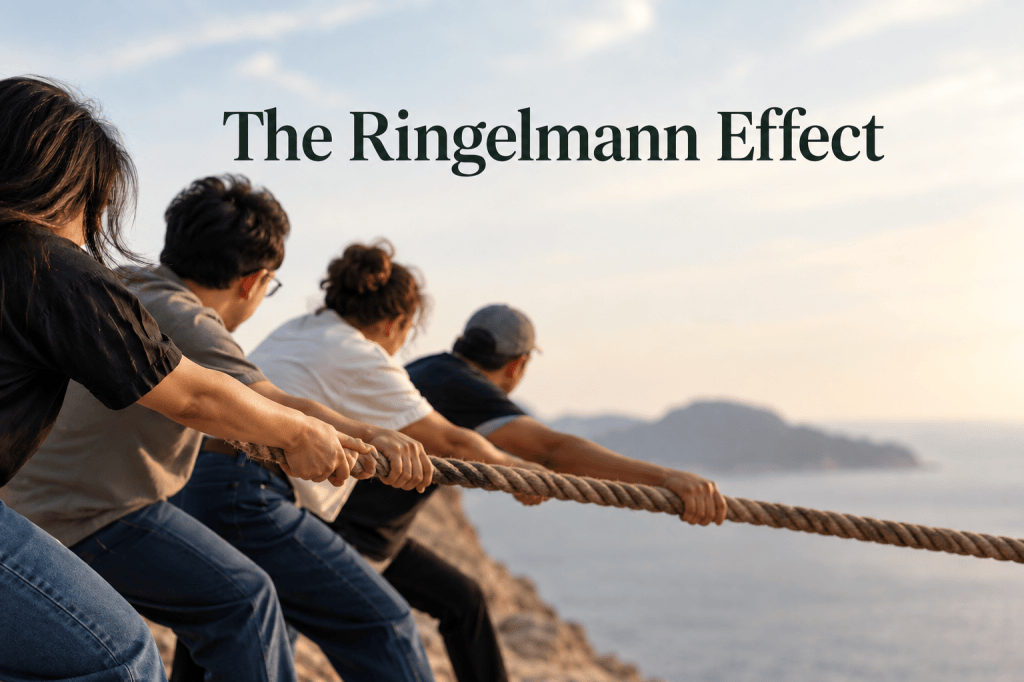
Back in the late 19th century, Max Ringelmann studied people pulling a rope. You’d expect that adding more people would increase the total force proportionally.
It didn’t. And as the group got bigger, the average effort of each person tended to decrease. Part of it had to do with coordination. Part of it had to do with individual effort becoming less visible. And honestly, I think freelancers and contractors see a version of this all the time.
“I did my part.”
Imagine a client campaign involving a strategist, copywriter, designer, funnel builder, ads person and VA.
Everyone completes their assignment.
The copywriter writes the copy.
The designer creates the graphics.
The funnel builder builds the page.
The ads person launches the campaign.
The VA sets everything up.
And then the campaign doesn’t work.
So whose fault is it? Maybe nobody’s. Everyone did exactly what they were contracted to do. And that’s where things get interesting.
Task ownership isn’t always the same as outcome ownership.
You can do your part perfectly and still end up with a project that doesn’t achieve what the client actually hired everyone to achieve.
This is where accountability gets a little blurry
When you’re working alone, there’s nowhere for the responsibility to hide.
When five contractors are involved, it becomes much easier to think: “That’s not my part.”
And sometimes, that’s completely fair. We shouldn’t expect every freelancer to suddenly become responsible for everything. But there still needs to be someone looking at the whole rope.
Someone who can see:
“This isn’t working.”
“That handoff is broken.”
“We’re waiting on approval.”
“The numbers don’t make sense.”
“The strategy needs to change.”
Because otherwise, you get a collection of completed tasks rather than a functioning system.
So what can freelancers and contractors do?
A few simple things help.
Know what you own.
Not just the task you’re completing, but the outcome you’re responsible for.
Make handoffs explicit.
Who gives what to whom, and what happens next?
Know who owns the bigger outcome.
It doesn’t have to be you. But someone should be able to say, “I’ve got this.”
And measure the result, not just the work.
“I sent the emails” is activity.
“The emails generated qualified conversations” is an outcome.
There’s a difference.
And perhaps most importantly, don’t confuse accountability with surveillance. A good contractor shouldn’t need someone hovering over them all day. But they do need clarity.
What am I responsible for?
What does done actually look like?
How will we know if this is working?
And if I spot a problem outside my little corner, am I expected to speak up?
But clients have a role too
If you’re the client hiring five VAs and freelancers, you are also part of the system.
And this is where I think clients sometimes unintentionally create the very problem they’re frustrated by.
You can have incredibly capable people and still end up with chaos if nobody has a clear view of how all the pieces fit together.
So before adding another person to the team, ask:
Who owns the outcome?
Not who is doing the Facebook posts.
Not who is building the funnel.
Not who is answering the inbox.
Who is looking at the whole picture?
It can be you.
It can be a project manager.
It can be an agency lead.
But somebody needs to own the result. It also helps to give each contractor a clearly defined lane. If three people think they’re responsible for the same thing, you’ve created overlap. If nobody thinks they’re responsible for something, you’ve created a gap. Neither one is particularly fun.
And clients have another important responsibility:
Give people the information they need to make good decisions.
If your copywriter doesn’t know the offer changed, your VA doesn’t know the launch date moved, and your ads person doesn’t know the landing page was rewritten, you don’t have a freelancer problem.
You have a communication problem. More meetings won’t necessarily fix that.
Sometimes what the team needs is simply one reliable source of truth. One project board. One brief. One set of priorities. One person who can answer, “What’s happening here?”
And maybe this is the part worth remembering
If you’re a freelancer, ask yourself:
Do I know what I’m actually accountable for?
If you’re a client, ask:
Have I made it possible for everyone to know what they’re accountable for?
Because accountability works in both directions.
The freelancer needs ownership. The client needs clarity. And the system needs someone watching the whole rope. Otherwise, you can end up with something that looks remarkably productive from the outside. You could have lots of people, lots of tasks completed, lots of activity and yet, have very little improvement.
Maybe that’s the real lesson of the Ringelmann effect.
More people can give you more capacity. But without clear ownership, they can also give you more places for responsibility to disappear.
And sometimes the question isn’t:
“Did everyone do their part?”
It’s:
“Did anyone own the whole thing?”







Leave a comment