
We usually think of consent as having enough information to make a decision. You know your options. You understand the facts. Nobody is forcing you. You choose.
But what happens when the environment in which you make that choice has already been carefully constructed for you?
Have you heard of Edward Bernays? You may not know his name, but you probably know his work. In 1928, he published Propaganda, openly describing the deliberate shaping of public opinion. I may be wrong, but I think the phrase, engineered consent came from him.
He was talking about shaping the conditions under which people would willingly choose something. As one of the architects of modern public relations, he knew you don’t always have to sell the product.
Why is it that we think of bacon and eggs as breakfast food? Stay with me here. This was one of Bernays’ famous campaigns. Beech-Nut wanted to sell more bacon. Rather than simply advertising and telling people to buy bacon, Bernays approached doctors and asked whether a heavier breakfast might be healthier than a lighter one.
This idea circulated through the press, with doctors becoming part of the story. Eventually, bacon and eggs became associated with a hearty American breakfast. And consumers didn’t have to be told to buy more bacon. The choice was constructed for them. The idea simply became part of the culture.
And that’s the interesting part. By the time an idea reaches us, we may have completely forgotten where it came from.
We simply think: That’s just how things are.
Bernays understood something else very well. It’s not just about buying products. People buy what those products mean. He helped in promoting cigarettes to women by associating smoking with independence and freedom. So a cigarette wasnt simply a cigarette anymore. It became a symbol. It became attached to an identity.
Engineered consent
The word propaganda has a negative connotation. We think political posters, war slogans, government broadcasts. But propaganda doesn’t always look like propaganda. Sometimes it looks like an article, a product review, an expert recommendation. Thats what makes engineered consent so interesting, and manipulative too (in a way).
If I tell you what to choose, you might resist and reject it. But what if I make one option feel normal and the other option feel strange? What if I attach one choice to success, intelligence, or morality? What if I make you feel that “people like us”naturally choose this?
Nobody has to force you. You choose. And yet the environment surrounding that choice may have been deliberately constructed for you.
“Sheeple mentality
It’s easy to read all this and think, “Yeah, so this is what they’re doing to everyone else.” There’s another group of people (and I think I belong here LOL) who question conformity. The ones who hear, “Everyone is thinking this,” and immediately ask: Why? The ones who look at the crowd moving in one direction and wonder whether everyone might be missing something. The person willing to look sideways notices something the rest of the room doesn’t.
But I think there is a trap there too. Rebellion can be marketed. Being different can become an identity. We grew up with James Dean, punk, grunge, goth, ripped jeans, Doc Martens, “alternative” everything.
The whole point was not to look like everyone else. And then somehow companies learned how to market rebellion. The look of not caring became a look you could buy. Grunge is probably one of my favourite examples. It came out of a culture that was, in many ways, pushing back against the polished mainstream pop culture. Then fashion figured out that people would happily pay money to look like they didn’t care about fashion. We bought the ripped jeans, flannel, those thrift store aesthetics. That “I don’t give a damn” look. And suddenly, rebellion has a price tag.
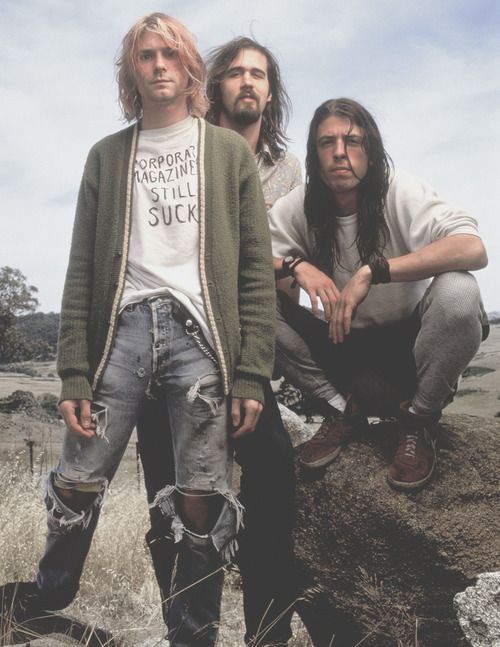
So the market doesn’t have to convince you to conform. Sometimes it can just sell us the identity of the person who refuses to conform. That’s the part worth noticing. And once an identity becomes recognizable, it can be packaged, marketed and sold right back to us.
Which means even rebellion is worth examining. Not because the rebellion wasn’t genuine. It often was.
But because anything that becomes a recognizable identity can eventually become a product.
Different herd.
Different uniform.
Same mechanism.







Leave a comment