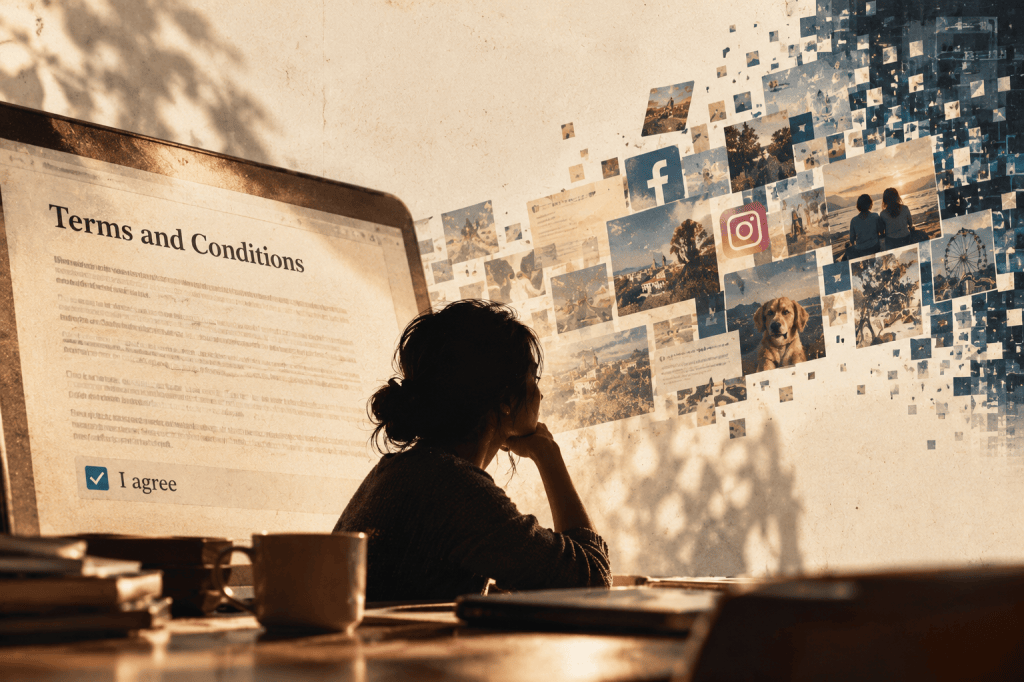
Remember when Facebook was still relatively new? We posted almost anything. Random thoughts, blurry photographs, song lyrics, what we had for lunch. Social media was becoming part of everyday life, and most of us were figuring it out as we went along.
I doubt many of us were thinking about artificial intelligence or what our personal information might be worth twenty years later.
Recently, I came across something interesting. Meta, the company behind Facebook and Instagram, has acknowledged using publicly shared posts, photographs, and other information to train its AI models. Some of that information reportedly goes back as far as 2007.
2007.
Think about how much you’ve changed since then. And now imagine that something you casually shared all those years ago could be contributing to technology that didn’t even exist in its present form when you posted it.
It made me wonder: What exactly did we agree to?
When consent becomes complicated
We’ve all encountered those lengthy terms and conditions. Most of us scroll to the bottom and click “I agree.” I certainly haven’t read every agreement I’ve accepted over the years.
But there’s something worth considering here.
If I agreed to share a photograph publicly in 2009, did I also agree to its possible use in training artificial intelligence years later? Could I reasonably have understood that possibility?
Of course, publicly available information has long been used for research, search engines, and technological development. Companies also need room to innovate, and AI systems can offer genuine benefits.
But there’s a difference between information being publicly accessible and people understanding all the ways it might eventually be used. Something can be legally permitted and still leave us questioning whether we truly understood the exchange.
Why I’ve become a bit of a social media hermit
As I’ve become more aware of how personal information is collected and used, my relationship with social media has changed.
I still use it. I read the news, follow updates, observe conversations, and occasionally participate. But I rarely post anything personal anymore. I’ve become quite the hermit when it comes to sharing my private life online.
It’s a conscious choice. I also create faceless content, which I actually find more meaningful in some ways. I like the idea that people can focus on the message rather than the messenger.
There’s a common belief, particularly among freelancers and business owners, that you are your brand, and therefore you need to put yourself out there. Show your face. Share your life. Let people get to know you.
I understand why that works for some people, and I respect their choice. But I don’t believe it’s the only way to build trust or create something valuable.
Personally, I’d rather be selective about what I share. That doesn’t mean I’ve somehow escaped data collection. I still use digital platforms, and those interactions generate information too. I’m simply more conscious of what I willingly make public.
Perhaps that’s the distinction that matters to me. Being online doesn’t have to mean making every part of ourselves available.
The agreement keeps changing
Technology evolves much faster than our understanding of its consequences.
We sign up for a service because it’s useful. Years pass. New features appear, business models change, and information we shared for one purpose becomes valuable for another.
Sometimes those changes benefit us. Sometimes they introduce risks we never anticipated. And the choices we have aren’t always equal. For example, European users have certain legal protections and opportunities to object to AI training uses that aren’t necessarily available to users elsewhere.
So privacy isn’t entirely a matter of personal responsibility. It’s also shaped by laws, corporate decisions, and the systems we participate in. I don’t think the answer is to abandon technology or become suspicious of everything. That would be rather exhausting, wouldn’t it?
But I do think we could become more deliberate about our digital lives. We can question what we’re agreeing to, review what we’ve made public, and decide which parts of ourselves we’re comfortable sharing.
For me, that means maintaining a quieter presence online. For someone else, it might look completely different. And that’s fine. What matters is having enough awareness to make that choice for ourselves. Because perhaps clicking “I agree” shouldn’t be the end of the conversation.
When we give a company permission to use a piece of our lives, how much of its future are we agreeing to give away?





Leave a Reply