
On AI-assisted writing, human thought, and the assumptions we make about both.
I came across a meme recently that made me laugh.
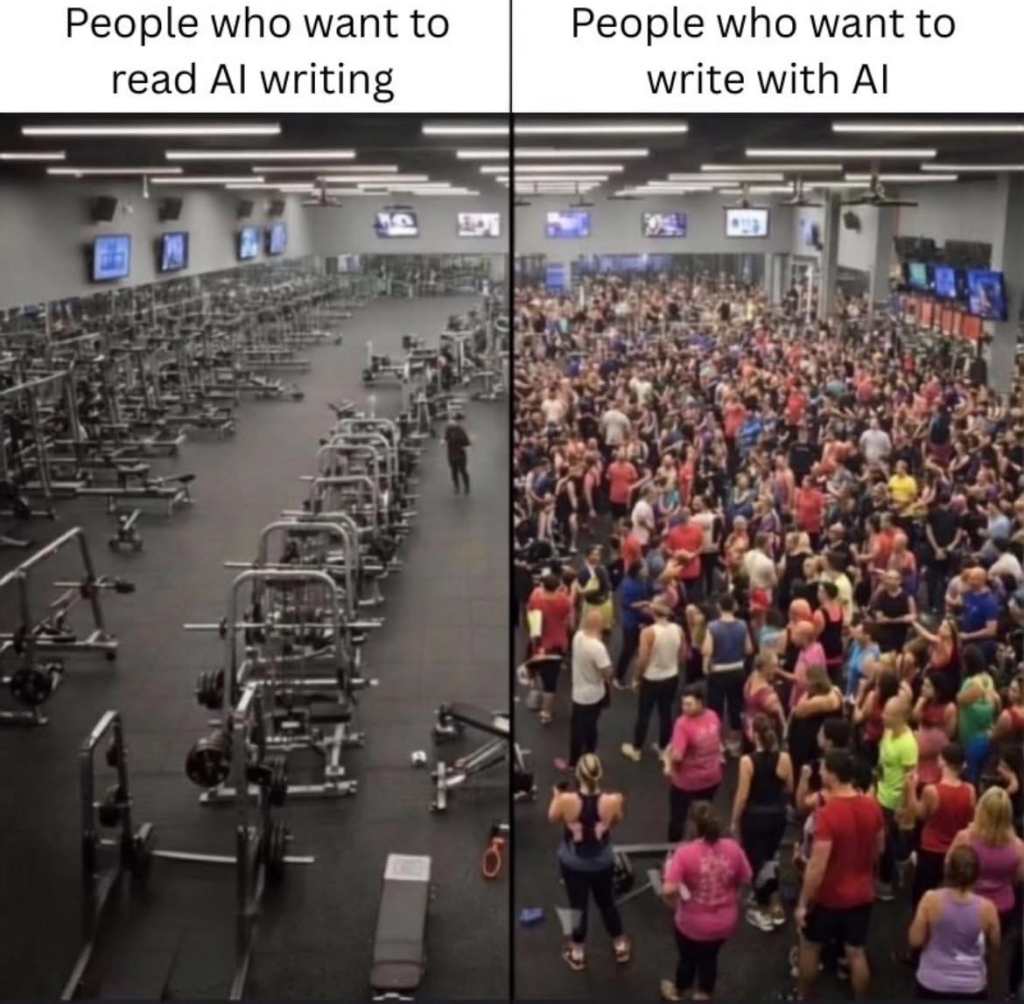
It showed two pictures of a gym. One was almost empty, labelled “People who want to read AI writing.” The other was packed with people, labelled “People who want to write with AI.”
Funny, because there’s some truth to it. We love having AI help us write. But when we come across something that sounds obviously AI-generated, we’re quick to dismiss it.
And I get it. We’ve all encountered those articles and social media posts that say a lot without really saying anything. The same phrases, the same predictable structure, the same polished language that somehow feels empty.
Then I thought, what if we’re becoming too quick to judge the thinking behind a piece of writing simply because AI was involved?
The Part of Writing We Don’t See
When we read something, we only see the finished words. We don’t see the hours someone spent thinking about an idea. We don’t see the conversations that helped shape it, the questions they struggled with, or the arguments they considered and eventually rejected. We see the result.
And now that AI has become part of how some people work through their ideas, that invisible process has become even more interesting.
Microsoft’s 2025 Work Trend Index surveyed 31,000 knowledge workers across 31 countries. Of those surveyed, 46% said they viewed AI as a thought partner, using it to challenge their thinking, brainstorm ideas, or spark creativity.
I wasn’t surprised that people were using AI as a thinking partner. I do that myself. Sometimes I have an idea that I can’t quite put into words. Sometimes I notice a pattern but haven’t figured out what it means. Other times, I want to challenge something I believe and see whether my reasoning holds up.
So I talk it through with AI. I ask questions. I disagree with its suggestions. I explore different perspectives. Sometimes I realize my original idea wasn’t as strong as I thought. Sometimes the conversation helps me understand exactly what I’ve been trying to say.
By the time I start writing, a lot of thinking has already happened. But none of that is visible to the person reading the finished article. They only see the words.
The Assumption Behind the Label
Here’s what I find interesting.
Two people could publish thoughtful articles on the same subject. One writes everything independently. The other uses AI to explore the subject, challenge assumptions, organize ideas, and improve how those ideas are expressed.
If both articles offer something worth thinking about, should discovering that one involved AI automatically make it less valuable?
I don’t think it should. Of course, there’s a difference between using AI to develop an idea and asking it to produce something you haven’t bothered to think about. That difference matters.
AI can make it incredibly easy to publish content without much effort or understanding. It can also produce convincing statements that are inaccurate, shallow, or misleading.
Those are fair reasons to criticize a piece of writing. But they’re reasons to examine the work itself, not to assume that every person who uses AI has surrendered their ability to think.
After all, people have always developed ideas through conversations, books, editors, teachers, and other influences. AI introduces new questions about authorship and responsibility because it can contribute so much to the final text. We shouldn’t ignore those questions. But we shouldn’t assume the answers are always simple, either.
Maybe We’re Judging the Wrong Thing
I wonder whether the label “AI-written” has become a shortcut. Sometimes we use it to describe writing that feels generic or lifeless. Other times, we use it simply because we suspect AI was involved. But those aren’t necessarily the same thing.
A piece can be written entirely by a human and still have nothing interesting to say. Another can be developed with AI assistance and contain observations, experiences, and questions that came from someone genuinely trying to understand something.
The tool alone doesn’t tell us how much thought went into the work. And perhaps that’s what bothers me about the way we sometimes dismiss AI-assisted writing.
We’re making a judgment about a process we haven’t seen. That doesn’t mean readers have to enjoy every article or overlook poor writing. And in situations where authorship or disclosure matters, people have every reason to ask how something was produced.
But when we’re reading an ordinary essay or reflection, perhaps the first question shouldn’t be whether AI helped write it. Perhaps it should be whether the ideas are worth our attention.
The Thinking We Never See
As AI becomes part of how people research, question, reflect, and develop their thoughts, the finished words may tell us less and less about how those ideas came together.
Some people will use AI to avoid thinking. Others will use it to think more deeply.
And from the outside, we may not always know the difference. So perhaps we should be a little more careful with our assumptions.
If something made us pause, reconsider an idea, or see something differently, does learning that AI helped shape the words erase the value of that experience?
I don’t think it does. The thinking behind a piece of writing may be invisible to us.
That doesn’t mean it wasn’t there.







Leave a Reply