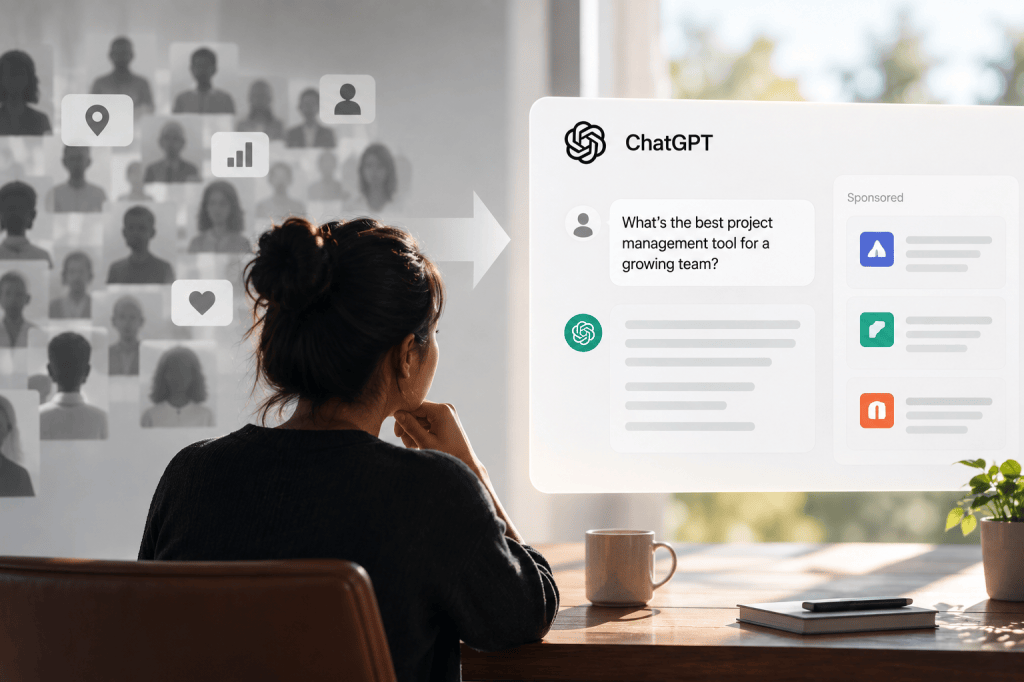
ChatGPT now has ads.
And while that might sound like just another advertising platform to add to the growing list of places businesses can spend their marketing budget, I think there’s something more interesting happening underneath.
OpenAI is building advertising into ChatGPT, where ads can be shown separately from the AI’s response and can be matched to the context and intent of a conversation.
That made me wonder:
What happens to advertising when the platform doesn’t just know what you searched for, but understands what you’re trying to solve?
From Audience to Intent
For years, digital advertising has gotten very good at answering:
Who are you?
Your age. Your location. Your interests. What you click on. What you buy.
We turn all of that into customer personas and use them to decide who should see our ads.
Imagine:
A 40-year-old business owner, running a growing company, interested in productivity and technology.
That’s useful information. But it doesn’t tell you whether that person needs your product today.
Now imagine they tell ChatGPT:
“My team has doubled in size and I’m spending hours every week chasing people for overdue invoices. Is there a better way to handle this?”
That’s a very different signal. We don’t just know who they are.
We know what they’re trying to solve. That’s intent.
Search Started This Shift
Google already gave us a glimpse of this.
Someone searching:
“Best accounting software for small business”
is giving you a pretty strong signal about what they’re looking for.
But conversational AI adds another layer.
People don’t just search. They explain. They give context. They describe what they’ve tried. They talk through their frustrations. Sometimes they don’t even know what the solution is called yet.
They just know:
“I have this problem. Help me figure it out.”
For marketers, that’s fascinating. Because it gives us another way to think about our customers.
Not just: Who is my customer?
But: What does my customer say when they’re trying to solve the problem I solve?
And This Is Where Content Comes In
If customers are increasingly using AI to ask questions, explore problems and compare options, there’s a bigger question for businesses:
What information about your business is available when those questions arise?
Does your website clearly explain the problems you solve?
Do your articles answer the questions your customers actually ask?
Does your content use the language they use?
Do you have useful information that demonstrates your expertise?
Because whether someone discovers you through Google, ChatGPT, LinkedIn, a podcast, or a recommendation, the underlying challenge is similar:
Can they understand why your business is relevant to the problem they’re trying to solve?
And that’s why I think ChatGPT Ads are interesting beyond the ads themselves.
They may be pointing toward a broader shift in marketing:
From targeting people based on who they are… to understanding them through what they’re trying to accomplish.
And if that’s where discovery is heading, then perhaps the question businesses should be asking isn’t simply:
“How do we advertise on ChatGPT?”
It’s:
“Have we made it clear enough what we know, who we help, and which problems we solve?”
Because before you worry about being discovered by AI, I’d start by making sure there’s something worth discovering.








Leave a comment